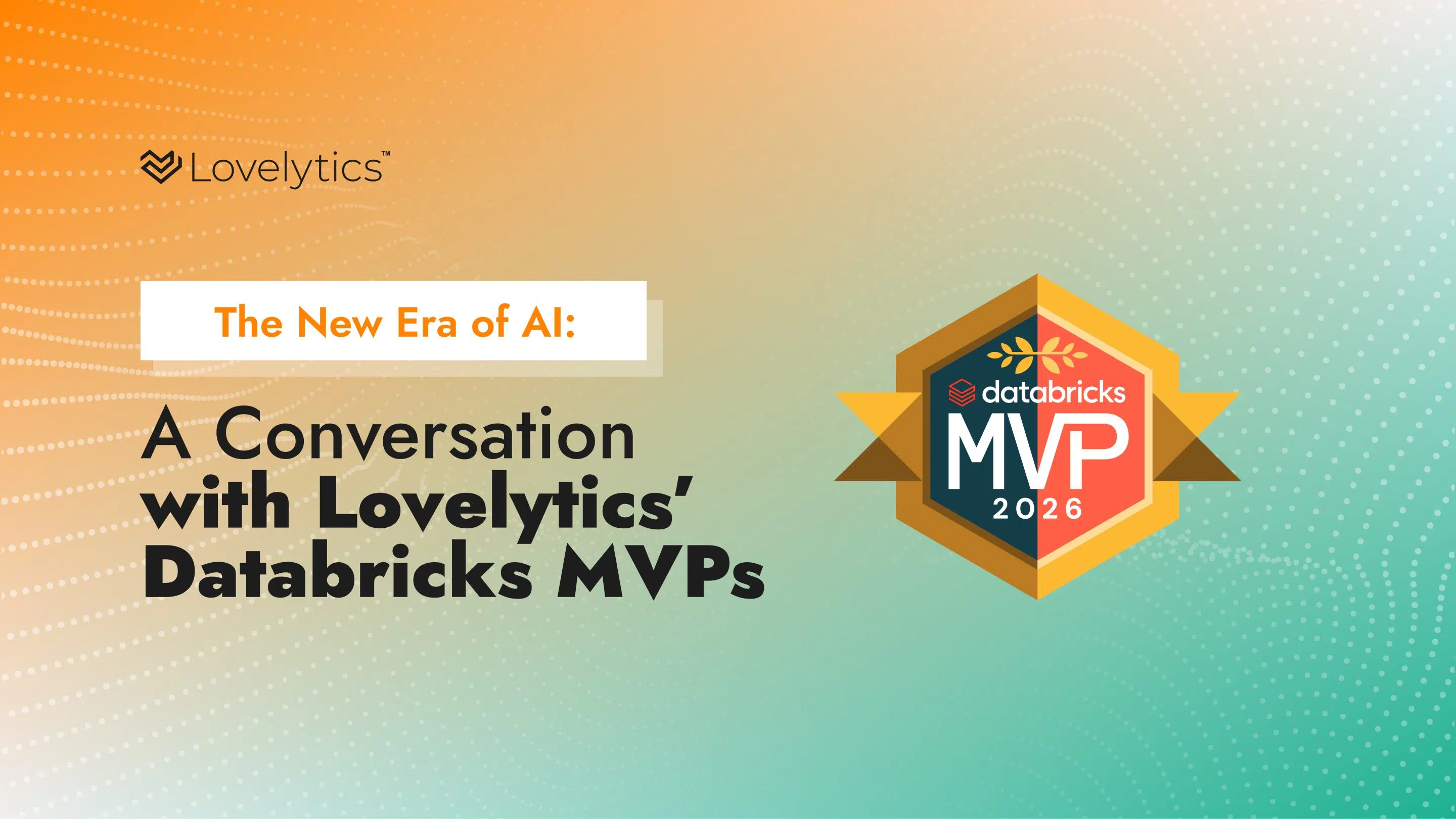
As AI reshapes the enterprise landscape, Databricks has launched a new AI MVP designation to recognize the practitioners leading the charge. We are thrilled to celebrate Sudhir Gajre and Tejas Pandit for being named to this elite group.
At Lovelytics, we believe AI is an engineering discipline, not a novelty. In this exclusive interview, our new MVPs share their perspectives on building reliable GenAI, the evolution of “Compound AI systems,” and their advice for leaders navigating this fast-moving ecosystem. Explore their insights in this article.
What does being recognized as a Databricks AI MVP mean to you?
Sudhir: Being recognized as a Databricks AI MVP is a meaningful honor because it reflects real-world impact with customers and contributions to the broader community. Databricks is the most compelling and innovative data and AI platform in the world, so recognition from them carries significant weight. I see this as both validation and responsibility to keep sharing what works, helping others level up, and representing pragmatic, enterprise-grade GenAI delivery.
Tejas: This recognition validates an approach I deeply believe in: building AI systems that deliver real business outcomes, not just impressive demos. Databricks has become the platform I trust for enterprise-grade AI, and recognition from them carries real weight. I see it as both an honor and a responsibility to help others navigate the noise and build GenAI that actually works.
What are your perspectives on the current state and future of Generative AI?
Sudhir: Generative AI has moved from experimentation to real enterprise value, but the gap between demos and durable production systems is still significant. The next phase will be about rigor, evaluation, governance, and integration into real workflows, not just model capabilities. The organizations that win will treat GenAI as a discipline of engineering and operating model change, not as a novelty.
Tejas: Generative AI has crossed the threshold from experimentation to enterprise value, but the gap between pilots and production remains significant. The next phase will reward organizations that treat GenAI as a discipline of engineering and change management, not a novelty. Success will require serious investment in data quality, evaluation frameworks, and human-in-the-loop design.
From a GenAI perspective, what do you find most compelling about the Databricks platform, and why should enterprises build on it?
Sudhir: The Databricks platform stands out because it unifies data, analytics, and AI on a single governed foundation, which is exactly what enterprise GenAI requires. I deeply admire the Databricks leadership for its strong roots in UC Berkeley academia, research-driven culture, and humility, which shows up clearly in the product direction. The platform is also refreshingly open, supporting a diverse ecosystem of open and closed models as well as third-party providers, which gives enterprises real flexibility.
Tejas: Databricks solves the integration challenge that derails most enterprise AI initiatives. Structured data, unstructured documents, vector search, and model inference all operate on a single governed platform. I also respect that Databricks remains open, supporting diverse models and third-party integrations rather than forcing proprietary lock-in. That flexibility is essential for enterprise adoption.
What advice would you offer to enterprise leaders, experienced professionals, and early-career talent navigating GenAI and the Databricks ecosystem?
Sudhir: For enterprise leaders, focus on real business problems and invest early in governance, evaluation, and operating model changes rather than chasing tools. For experienced professionals, the opportunity is to combine domain expertise with hands-on GenAI skills and become builders, not just advisors. For early-career talent, deep fluency in platforms like Databricks and a bias toward experimentation will be a powerful career advantage.
Tejas: For enterprise leaders: invest in your data foundation before chasing AI capabilities, and scope narrowly before expanding. For experienced professionals: your ability to translate business problems into technical solutions is more valuable than ever, so become a builder, not just an advisor. For early-career talent: develop fluency in platforms like Databricks, learn to think in pipelines rather than notebooks, and seek out the messy real-world problems that tutorials avoid.
What real-world impact have you seen GenAI deliver for enterprises, and what differentiates successful implementations from failed ones?
Sudhir: I have seen GenAI reduce cycle times, improve decision quality, and unlock entirely new capabilities when it is embedded directly into real workflows. In several cases, AI agents that can reason across documents, invoke tools, and take actions have transformed workflows such as claims intake, contract analysis, and customer support triage. The difference between success and failure almost always comes down to discipline: strong problem framing, high-quality data and context, evaluation-driven iteration, and close partnership with business users.
Tejas: I have seen document processing workflows reduced from days to minutes and manual triage replaced by intelligent routing and automated decision-making. What separates success from failure is discipline: clear problem framing, rigorous evaluation before deployment, and designing for exceptions rather than assuming the happy path. Teams that iterate based on metrics consistently outperform teams that ship based on intuition.
What are common misconceptions about GenAI or AI agents that leaders should move past?
Sudhir: Many leaders overestimate what models can do out of the box and underestimate the engineering, data quality, and operating rigor required to make GenAI reliable. Another misconception is that agents are magic, when in reality they require careful scoping, guardrails, evaluation, and strong system design. Organizations that move past hype and treat this as an engineering and change-management challenge make far more durable progress.
Tejas: The biggest misconception is that agents operate autonomously with minimal oversight. In practice, the most effective agent architectures are carefully constrained, with guardrails, confidence thresholds, and human checkpoints at critical decision points. Leaders should also recognize that the data quality and engineering rigor required to make GenAI reliable is substantial and often underestimated.
Where do you see enterprise GenAI and agentic systems heading over the next 12 to 24 months?
Sudhir: Over the next 12 to 24 months, we will see GenAI move decisively toward agentic systems that are deeply embedded into enterprise workflows rather than standalone tools. Enterprise adoption will accelerate, and this will be the period where real value emerges from productionized deployments rather than pilots. The focus will shift from model novelty to reliability, orchestration, evaluation, and governance at scale, with organizations that invest now creating durable competitive advantage.
Tejas: Compound AI systems will become the standard architecture, combining retrieval, multiple model calls, tool execution, and validation into orchestrated workflows. The focus will shift from model selection to system design, observability, and governance at scale. Organizations investing in these capabilities now will establish durable competitive advantage as the market matures.
What excites you most about the direction Databricks is taking in AI and GenAI?
Sudhir: What excites me most is how intentionally Databricks is building toward enterprise-grade AI rather than chasing hype cycles. Investments in Agent Bricks, MLflow, DSPy, governance, and evaluation signal a serious commitment to production-grade agentic systems, not just experimentation. It feels like a platform designed by practitioners for practitioners, which aligns closely with how durable AI needs to be built.
Tejas: What excites me most is how intentionally Databricks is building for production AI rather than chasing hype. The investments in AI Functions, serverless infrastructure, MLflow, and the broader agent ecosystem demonstrate a commitment to how enterprise AI actually gets built and operated. It is a platform designed by practitioners who understand what it takes to ship reliable systems at scale.
Being part of the inaugural class of Databricks AI MVPs is a testament to the talent and dedication of our team at Lovelytics. The insights shared by Sudhir and Tejas highlight that the future of AI belongs to those who prioritize data quality, governance, and real-world results over hype. Congratulations to both for setting the standard in this new era of AI.