Rob Saker recently wrote something that stopped a lot of people in our industry mid-scroll. In his “AI is Eating Enterprise SaaS” article, he made a compelling case that the collapse of vertical software moats isn’t a threat to consulting, it’s the biggest opportunity the profession has seen in a generation.
His argument: As AI dissolves the rigid software that once defined enterprise business processes, someone has to help organizations reimagine how their value chains connect. And that someone isn’t a generalist with a slide deck. It’s a consultant with deep, irreplaceable domain expertise.
Rob is right. And we’d like to introduce you to exactly that.
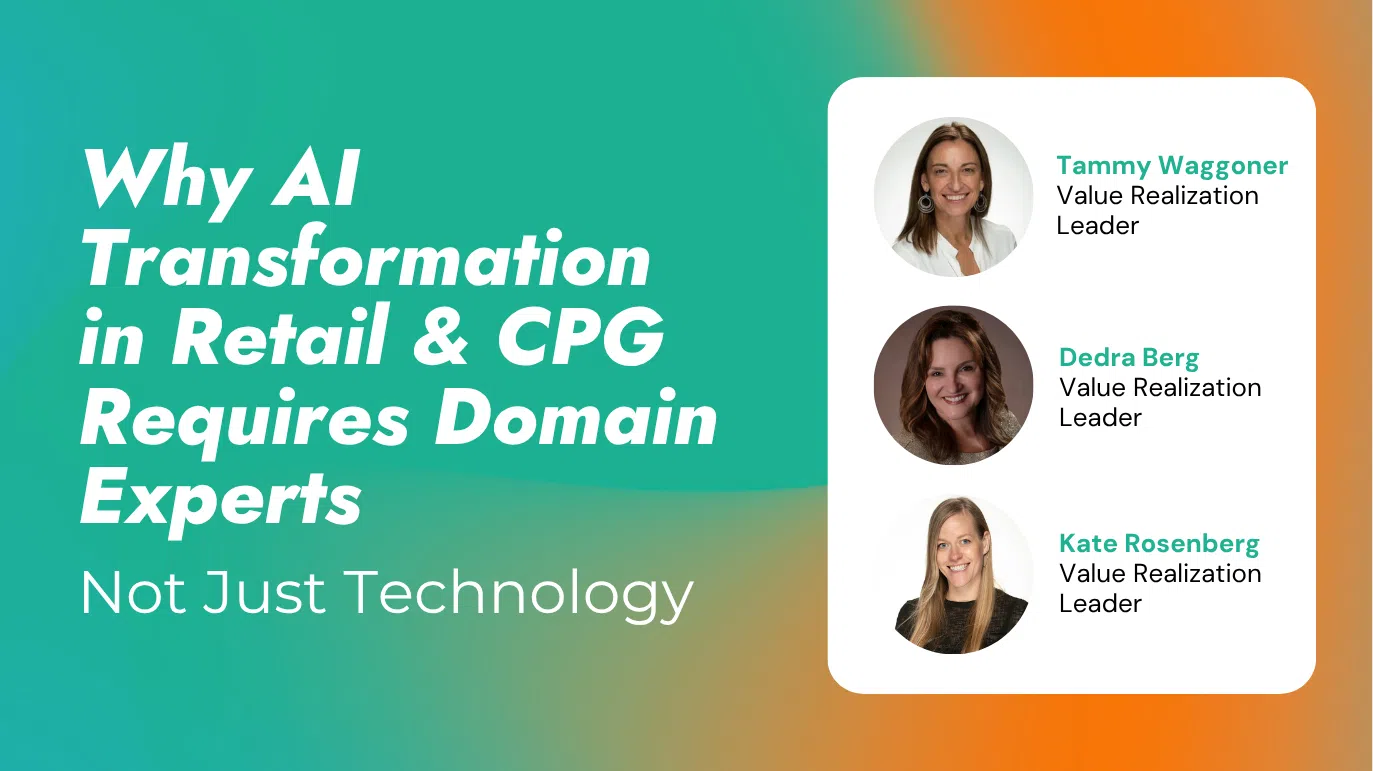
Meet the Lovelytics Value Realization Practice
At Lovelytics, we’ve built our Value Realization practice around a simple belief: technology is only one part of an AI transformation’s value. The other part comes from how the business adapts its processes, decisions, handoffs, and people.
That’s not a technology problem. That’s a domain expertise problem.
Which is why we went out and found people who have spent decades inside the exact businesses our clients are trying to transform.
Tammy Waggoner: The Transformation Architect
Tammy has spent over 25 years at the intersection of people, process, and commercial strategy at companies like Tyson Foods and Hillshire Brands. She’s the person organizations called when they needed to untangle a complex transformation and actually get it to stick.
During her tenure at Tyson, where she rose to VP of Commercial Capabilities, Sales Enablement, and Sales Finance, she rolled out foundational sales training to 1,000 team members, standing up CRM systems, and leading large-scale process transformations across the commercial organization. She wasn’t implementing tools. She was rewiring how teams operated.
What makes Tammy rare is this combination: she understands the finance, the sales motion, the organizational dynamics, and (critically) the human side of change. She knows why transformations fail, because she’s been in the room when they do, and she’s been the one to course-correct.
At Lovelytics, she leads our Value Realization practice, which helps clients move beyond proof of concept to enterprise-wide impact. That’s not a coincidence. It’s exactly what her career has been building toward.
Dedra Berg: The Brand and Category Strategist
Dedra has spent her career leading growth inside large, complex consumer goods organizations, including Fortune 100 companies, where success depends on aligning brand strategy, sales, category insight, innovation, and execution across national retailers.
She has built and led cross-functional teams spanning consumer insights, shopper marketing, innovation, and sales, while also owning P&Ls, managing multimillion-dollar trade and marketing investments, and helping shape the operational and commercial strategies required to grow share in competitive markets.
What makes Dedra especially valuable in AI transformation work is that she understands how growth actually happens and where it often breaks down. She knows how consumer demand connects to category strategy, customer planning, trade investment, supply chain realities, and in-store execution.
She understands that commercial teams do not just need more data. They need better decision support grounded in the realities of how the business runs. That is not something you can learn from a dashboard.
This breadth of experience is exactly what gives her perspective real weight in an AI-native world. She brings the judgment of someone who has not just analyzed commercial growth from the outside, but built it from the inside.
Kate Rosenberg: The Trade and Commercial Operations Expert
Kate specializes in turning business strategy into real, measurable results. Over two decades in the CPG industry, she has played a key role in shaping and enabling the commercial engine that translates data and trade investment into revenue growth.
Kate’s expertise connects data, process, and technology. As a product owner for TPM and RGM systems, she has helped define requirements and roadmaps for tools used to plan and optimize trade investment—while also driving the development of forecasting models, ROI frameworks, and planning processes that ensure those tools deliver business value.
She understands not just how companies invest in pricing and promotions, but the full value chain from planning through execution, reconciliation, and financial realization. This includes the gaps, inefficiencies, and workarounds that most AI tools miss because they were never designed with that complexity in mind.
Fluent in the cross-functional language that spans Sales, Finance, and IT, Kate translates complex data into actionable strategies and designs the processes needed to unlock value from data and AI investments, with a practical, outcomes-driven focus on turning insight into impact.
Why This Matters Right Now
Saker’s article is right about the moment we’re in. Enterprise software moats are eroding. AI agents are beginning to replace the rigid, codified workflows that SaaS platforms spent decades locking in. And the companies that move first (redesigning their value chains before the competition does) will capture disproportionate value.
But here’s what he’s also right about: this work requires someone who understands why a retailer’s promotional calendar creates supply chain constraints the CPG company’s systems don’t account for. Someone who knows that seasonal demand patterns for fresh meats behave differently than shelf-stable categories. Someone who has personally lived the gap between a $400 million trade budget and the insight needed to deploy it wisely.
Tammy, Dedra, and Kate have lived all of it. And now they’re at Lovelytics — helping CPG and retail organizations turn AI potential into operational reality.
If you’re a consumer goods or retail company trying to figure out what comes next, we’d love to talk.
Take the guesswork out of bridging the gap between AI technology and business impact. Leverage the decades of real-world retail & CPG leadership from Tammy, Dedra, and Kate to turn your AI potential into operational reality.