
AI/BI Genie is an agent that allows us to interact with data through conversation. In this article, we’ll explain what challenges it addresses, how much it costs, and walk you through a step-by-step tutorial on how to use it.
Today, data visualization isn’t just a chart—it’s an interface. A space where people—technical or not—meet data to make decisions, explore insights, or communicate findings.
Artificial intelligence isn’t here to replace dashboards or classic reports—it’s here to add a new layer: allowing anyone to talk to their data, ask questions, and get answers without relying on another team.
What is AI/BI Genie?
AI/BI Genie is Databricks’ conversational access tool for data. It’s part of the broader AI/BI platform, which brings together the two main pillars of modern data visualization:
- AI/BI Dashboards, for secure, accessible reporting
- AI/BI Genie, a chat-based interface that lets users ask questions and get fast, reliable answers
As we’ll explain later, AI/BI Genie relies on metadata from Unity Catalog to function.
Conversational data access requires a responsible, well-governed approach. It’s critical to understand who the product is for, how information is prioritized, how data security is enforced, and—most importantly—how we support users through this new paradigm.
What challenges does AI/BI Genie solve?
AI/BI Genie is designed to help people engage with data through conversation. Behind this is the goal of true self-service: enabling users to get the data they need on their own.
Although this idea has been around for years, our industry still hasn’t fully delivered on the promise. It’s not just a tech challenge—it requires data governance maturity so people can access high-quality data and use it meaningfully.
For organizations that truly see data as a core asset, building an open data culture is essential. That’s a big organizational shift: instead of waiting for information to arrive, people need to seek it out. The technical tools are the easy part—the real challenge is cultural.
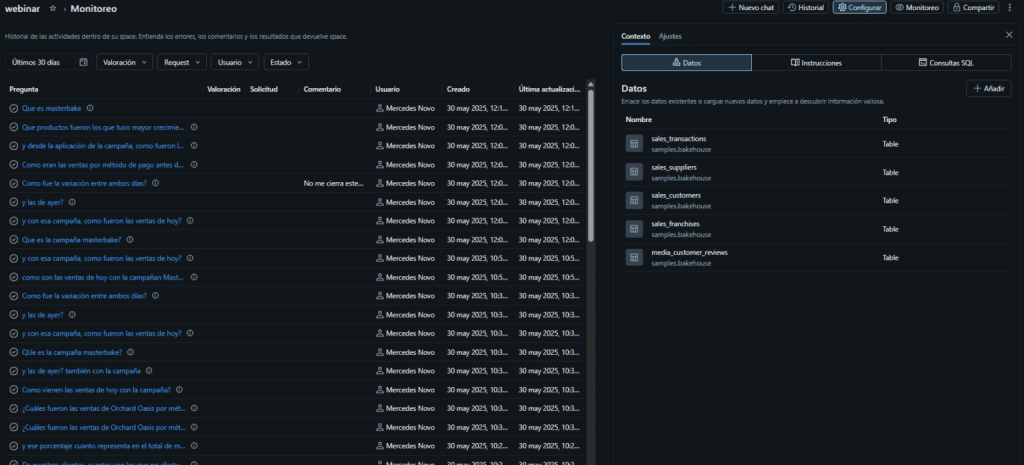
In that context, AI/BI Genie is about enabling conversational access to unlock data self-service.
It’s not just a new tool—it’s aligned with how people communicate today. We don’t make phone calls anymore; we message. So why not use messaging to work with data?
How much does AI/BI Genie cost?
There’s no additional license required to use AI/BI Genie—it’s included in the Databricks platform. However, you do need either SQL Pro or SQL Serverless.
Databricks only charges for compute usage, not for the LLM model. For example, if a user asks a question that requires a query against the gold layer of the data lake, you’ll be charged for that query’s runtime only.
With no extra licensing costs, Genie is a cost-effective solution.
How does AI/BI Genie work?
AI/BI Genie is a Compound AI System—a collection of agents that work together.
Instead of building one all-powerful model, Genie is made up of smaller agents, each with a specific function, that collaborate to deliver business value. In this case: engaging with users, retrieving the right data, and presenting it clearly.
Some of the agents might be responsible for:
- Planning data access.
- Conversing with the user.
- Mapping user questions to available metadata.
- Validating results.
- Certifying outputs.
In short, this isn’t just an LLM—it’s a coordinated system of agents working together to deliver a mature conversational data experience.

How does AI/BI Genie connect to Unity Catalog?
To operate in a governed environment, AI/BI Genie requires Unity Catalog, Databricks’ data governance layer.
All the information Genie uses to interact with data comes from this catalog, which is why governance is essential.
This includes:
- Technical metadata: the core data structure
- Descriptive metadata: field descriptions, table relationships, usage metrics (frequent queries and prompts), chat history, example queries, and system instructions
Using this metadata, Genie interprets what the user is asking and connects it to the available data.

How to use AI/BI Genie?
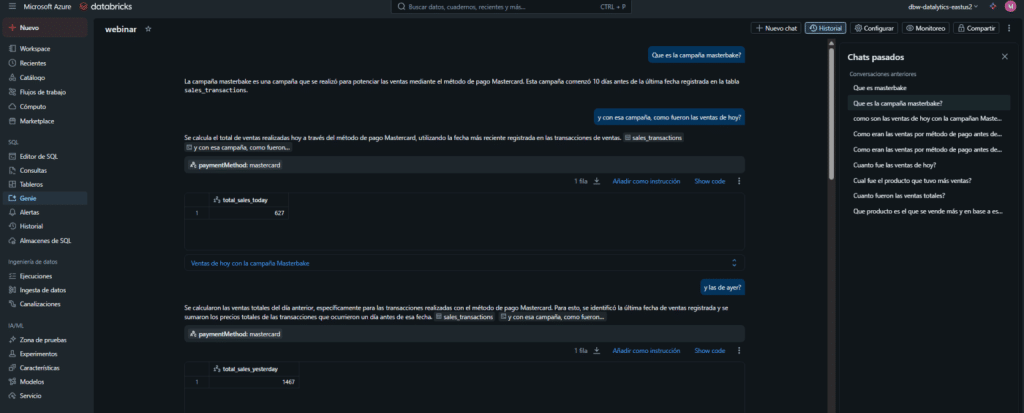
In this hands-on demo video, we walk through how to use AI/BI Genie and how to maintain it.
Conclusion
AI/BI Genie isn’t just another feature—it’s not a one-off advancement like associative models replacing data warehouses or in-memory tech revolutionizing performance. It’s something else: the technical expression of a new era in how we consume data.
Exploring data isn’t a new concept—OLAP cubes have been doing that for years—but what’s changed is the channel and the user experience. Instead of technical or visual interfaces, we now use the most familiar and natural medium: messaging. People don’t call anymore—they chat. So why not apply that to data?
AI/BI Genie makes that shift real. It lets people query data as if they were chatting with a colleague. It doesn’t replace traditional dashboards or reports—it powerfully complements them. Most importantly, it finally enables that long-promised goal of real self-service, with no technical barriers or steep learning curves.
And this is just the beginning. The real potential lies in integration—embedding AI/BI Genie into tools like Slack, Teams, or any compound AI system. In doing so, Genie doesn’t just enable data conversations—it becomes a key player in a larger intelligent ecosystem. One more agent in an expanding AI architecture.
With a curated, governed environment, organizations can even start opening data access internally—or externally to partners and third parties. In the end, Genie isn’t just a tool—it’s the gateway to a new way of thinking about data access, data consumption, and data culture.
–
This article was originally written in Spanish and translated into English using ChatGPT.
–
* This content was originally published on Datalytics.com. Datalytics and Lovelytics merged in January 2025.