Nearly every large contractor and owner now runs a Common Data Environment (CDE) compliant with ISO 19650. But most still can’t answer basic portfolio-level questions without days of manual work. Do any of these sound familiar to you?
- “Which projects are trending over budget once change orders are accounted for?”
- “Where is rework concentrated across regions, and which vendors are driving it?”
- “Do we have the data quality to actually trust an AI forecast?”
If you’re piecing together the answer from five spreadsheets and a few frustrated emails, you’re not alone and it’s not a tooling problem, it’s a data structure problem.
Despite having more structured project data than ever, most contractors still lack the unified layer that turns it into a real single source of truth.
In this post, I’ll share how our most successful construction clients are approaching unified data governance, make a compelling case why a project-centric CDE on its own isn’t enough anymore, and show what we’ve built to solve data fragmentation for large contractors and EPC firms
Why is unifying construction data hard?
CDEs were built to govern project documents, not enterprise data. They’re great at managing drawings and models under ISO 19650 but they were never designed to unify a multi-project capital plan.
That gap shows up fast. ERP, scheduling, and safety systems were all built independently, so portfolio forecasting stays stuck in manual spreadsheets. And it only gets worse as firms grow: every acquisition adds another disconnected system to the pile, making it harder for leadership to get a live view of risk.
Here’s what that looks like in practice:
Say a GC acquires a regional subcontractor with its own scheduling and safety systems. Six months later, someone on the exec team asks for a consolidated view of delay risk across the combined portfolio and the answer requires three people, two weeks, and a shared spreadsheet, because “delay” means something slightly different in each system.
That’s the real cost of fragmentation. Without a shared data model, “project cost” or “delay” doesn’t mean the same thing twice, and teams end up spending their time reconciling numbers instead of acting on them. Unifying that layer is what lets a firm move from reactive reporting to actually steering the portfolio.
What is the difference between a CDE and an enterprise single source of truth?
A CDE manages the document trail for a single project. An enterprise single source of truth gives you live visibility across your entire portfolio. Getting there means connecting your CDE’s project data with financials, labor, and safety data in one governed layer.
That’s the difference between checking a project’s status and actually trusting the numbers enough to make a real investment decision.
What a gold standard single source of truth looks like in construction
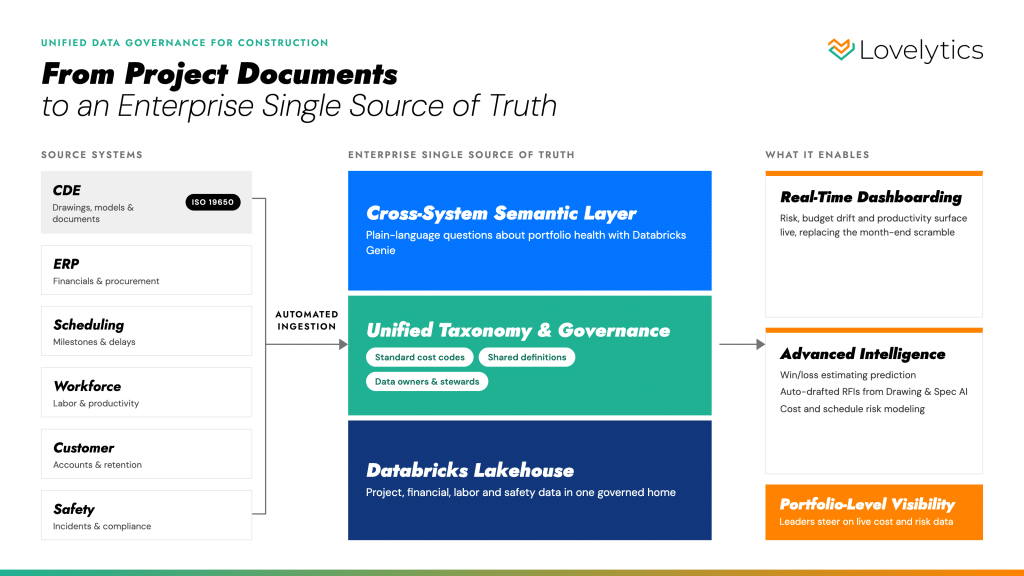
- Unified Taxonomy: Standardized cost codes and definitions, so every reporting system means the same thing.
- Automated Data Ingestion: CDE, ERP, scheduling, workforce, customer, and safety data flow directly into a centralized Lakehouse, giving you the total picture without manual pulls.
- Cross-System Semantic Layer: Natural language querying, like Databricks Genie, so anyone on the team can ask plain-language questions about portfolio health.
- Real-Time Dashboarding: Risk, budget drift, and productivity metrics surface live, replacing the slow month-end scramble.
- Advanced Intelligence: Estimating intelligence for win/loss prediction, Drawing & Spec AI for auto-drafted RFIs, and cost/schedule risk modeling.
How does unified data governance solve this?
Portfolio-level visibility. Executives steer the business using real-time cost and risk data, not month-old snapshots. No more manual spreadsheet reconciliation, and no more waiting to catch a project drifting from budget.
Centralized governance. One taxonomy across CDE, ERP, and safety systems means a KPI means the same thing everywhere it shows up. Fewer communication errors, less rework spent arguing about whose numbers are right.
AI-powered decision making. This only works once the data underneath it is unified and governed. With that foundation in place, natural-language forecasting and risk-flagging let project leads catch a delay weeks before it hits the bottom line, not after.
What this looks like in practice
To see how this plays out inside a real contractor, we sat down with Atishaya Jain (AJ), one of our construction and engineering data experts who works with these firms every day.
Growth by acquisition is where the problem starts. Large contractors and EPC firms run programs at enormous scale, from residential complexes to stadiums, and sometimes the entire cities. As they are in services businesses, the have constant need of skilled labor, expertise, and domains. The way they scale is by acquiring companies in the same industries. As AJ put it, each acquisition brings its own compleixities – business structure, their definition of customers, hierarchy, products, services, etc. The focus is to grow – win and deliver more projects. What takes the backseat – consistency and standardization across the Business units/Sub-companies.
The result is that simple questions get slow and unreliable. Ask “what’s our customer retention?” and the answer depends on the Business unit you ask. Ask for a P&L by geography or business unit, and someone has to pull data from each local ERP, drop it into Excel and massage it. By the time the numbers reach the executive team, they’re weeks or even a month old.
The pressure is only growing. Firms are now pulling in data from drones, from sensors embedded in the fleet or equipments. Even a basic question like “where’s my truck right now?” is a data question. AJ was clear that a unified Data Governance has become the bottleneck, which firms need to clear before they can scale further.
So where should a firm start? AJ’s advice is to begin with people before technology:
- Get executive buy-in first. The realization has to happen at the C-suite level. They need to accept the urgency and benefits, lay out the vision, and clear roadblocks for the team. With a dozen or more semi-autonomous companies under one roof, a ground-up approach won’t hold, and AJ said it will fail.
- Make it an Enterprise vision. Once leadership owns it, it becomes a shared initiative led from the top rather than a side project in one business unit.
- Find a champion in every unit. Identify one senior leader from each unit, who believes in the vision, is passionate about driving things, and can steer his unit in right direction.
- Collect and align definitions. Gather how each unit defines customer, location, cost, services, and the rest. Once those definitions are on the table, the focus then moves towards standard definitions and how to leverage technology to keep it consistent.
- Name your data owners and stewards. This is critical element in keeping things well-defined and governed on ongoing basis. Some organizations don’t have a formal identified person for these roles, even if they are doing most of the work. Define the roles, identify the individual, clarify expectations, and help them to be successful in their role.
AJ won’t call it easy, but with executive sponsorship and named owners it becomes easier, and that’s the point where the technology can deliver on its potential.
That’s the thinking behind Constructionlytics. Bring data from across your systems onto one platform, put governance and shared definitions on top, and then turn on the KPIs. It’s a broad umbrella offering for construction and engineering firms, and data governance is one important piece of it rather than the whole story.
The future of construction data: Constructionlytics
Constructionytics is our specialized end-to-end accelerator (AI blueprint) designed to solve data fragmentation for large contractors and EPC firms. It builds on the Databricks Lakehouse to create a construction-specific unified layer that drives better estimating win rates and reduced RFI response times.
We are continuing to evolve this accelerator and are actively seeking partners to help shape its impact on industry-specific use cases. This is a unique opportunity to influence a platform built specifically for construction engineering challenges.
Our goal is to partner with organizations that are ready to bridge the gap between project-level data and enterprise visibility. If your team is struggling with stalled GenAI initiatives due to data readiness, we want to help implement this accelerator with you.
Our ideal partner for this looks like:
- A general contractor, owner, or EPC firm managing a multi-project or multi-region portfolio
- A CDO, CAO, or VP of Data/Governance mandate already in place, with executive sponsorship for a data unification initiative
- An existing CDE (any platform) plus at least one other major system (ERP, scheduling, or safety) that isn’t currently connected to it
- Early interest in AI/GenAI use cases that are currently stalled by data readiness or governance gaps
If that sounds like your organization, we’d welcome the conversation, not as a sales pitch, but as a genuine build partnership.
Constructionytics outcomes
- Unified Lakehouse Ingestion: Automatically centralizes project, ERP, and safety data into a governed home.
- Natural Language AI: Enables non-technical users to ask complex questions about portfolio health instantly.
- Live Risk Surfaces: Connects insights directly to action by flagging budget drift in real time.
Directionally, what could this look like?
Constructionytics targets a significantly lower implementation cost and faster time-to-value than custom data platforms. By starting with a repeatable accelerator, firms can reduce the time spent on rework and manual reconciliation.
- Meaningfully lower implementation cost than a custom-built enterprise data platform, by starting from a repeatable accelerator rather than a blank slate
- Materially faster time-to-value than a traditional multi-year data warehouse build
- A measurable reduction in rework and reconciliation spend once cost codes and definitions are unified across systems
The platform aims to materially reduce rework spend once cost codes are unified across all systems. We are looking for founding partners to help us benchmark these directional targets in a real-world environment.
Conclusion
AI-readiness in construction requires a data foundation that sits above the CDE and connects to the rest of the business. By solving the enterprise data problem with Constructionytics, organizations can finally achieve a true single source of truth.
Interested in shaping the future of construction data?
If you’re serious about teaming up and meet the criteria listed above, we’d love to partner and deploy Constructionlytics at your business. To make it easy on your end, follow these steps:
- Add me on LinkedIn
- Send this note (feel free to customize if you want) “Hi Ben, I read your blog and would love to explore Constructionlytics. Do you have time to connect (ideal date and time)?”
FAQ
Is a CDE the same as a single source of truth?
A CDE is a single source of truth for project information — models, drawings, and documents — under ISO 19650. It’s not designed to unify enterprise data like financials, supply chain, or cross-project reporting, which is where a broader data governance layer is needed.
What data do we need to unify beyond our CDE?
Most organizations get the most value from connecting ERP (financials, procurement), scheduling, and safety data to their existing CDE and project data, so leadership can see cost, schedule, and risk together at a portfolio level.
What if our data isn’t on Databricks yet?
That’s fine — a federated approach can connect systems that live elsewhere, while prioritizing the highest-value data for full ingestion into the Lakehouse over time.
What if our GIS/BIM data quality is poor?
Data quality issues are common and solvable. An early assessment can identify where cleanup or conflation work is needed before building governed reporting on top of it.