

92%
$35M
$20M
$3M
10
THE CHALLENGE
As the largest pizza company in the world, Domino’s recognized that its legacy, on-premise infrastructure, rigid single-identifier matching, and siloed systems hadn’t kept pace with its ambition — often taking up to 24 hours for data to become usable and limiting the household-level personalization needed to get the right order to the right customer at the right time.
With a data center exit on the horizon, Domino’s saw the moment to modernize. Customer records were matched using rigid, single-identifier logic that couldn’t keep pace with how people actually order today: in-store, online, via app, or through third-party delivery.
THE SOLUTION
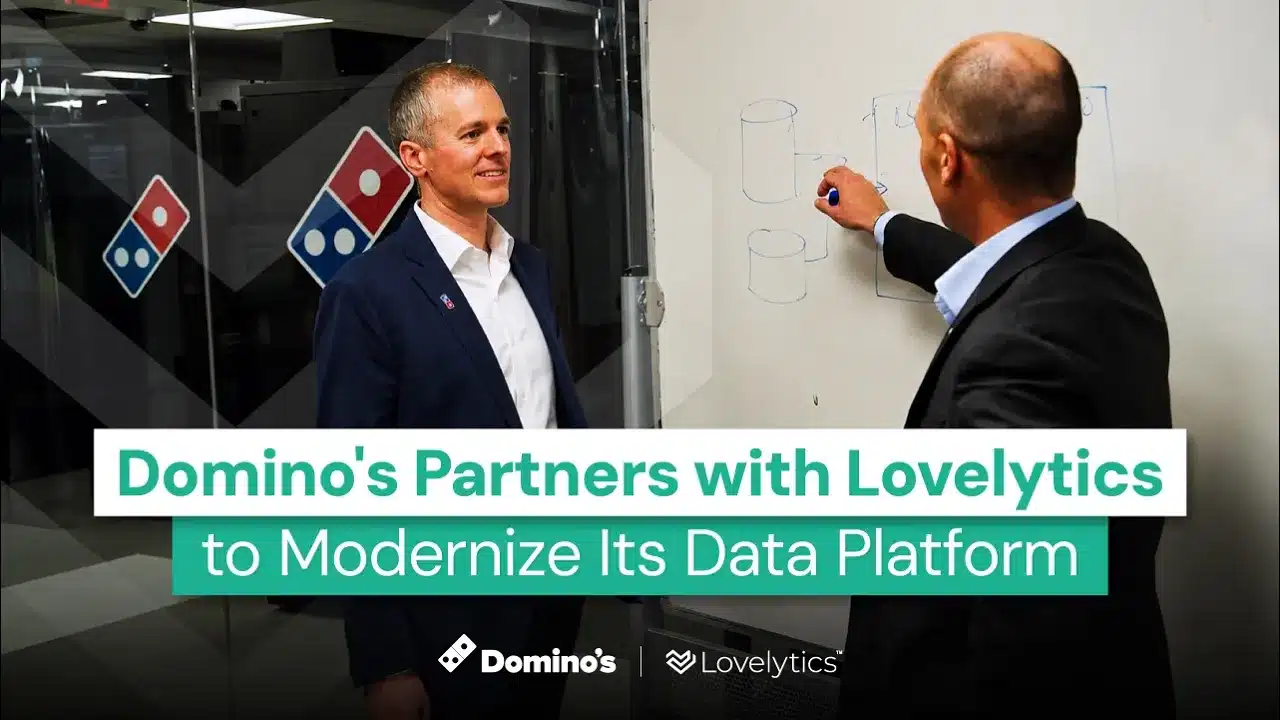
Lovelytics partnered with Domino’s to execute an enterprise data transformation on Azure Databricks — migrating the legacy warehouse, resolving customer identity across every channel, and layering in governed, AI-powered analytics so the business could confidently trust and act on its data.
FULL STORY
Domino’s has built its brand on speed and reliability. The Tracker customers watch while their pizza gets made is iconic, a small promise of transparency that customers have come to love (and expect).
Behind the scenes, Domino’s was determined to make sure the infrastructure powering that promise could keep up. The company still owned and operated much of its data platforms out of its headquarters, and with a data center exit on the horizon, Domino’s saw the moment to modernize.
Customer records were matched using rigid, single-identifier logic that couldn’t keep pace with how people actually order today: in-store, online, via app, or through third-party delivery. And it could take up to a full day for new data to become usable, a lag that quietly distorted the KPIs leadership relied on, inflating new-customer counts and limiting how precisely marketing could personalize offers to get the right order to the right customer at the right time.
Domino’s knew what was at stake, they just needed a partner who could move fast without breaking what already worked for millions of customers a day.
Building the Platform, Piece by Piece
Domino’s had spent years building and running its own data platforms out of company headquarters, and the team knew that whatever came next needed to do more than just move data to the cloud.
After evaluating a number of platforms, Domino’s chose Databricks for its pace of innovation and the cost efficiencies unlocked through its partnership with Microsoft.
Together, Databricks, Lovelytics and Domino’s approached the transformation as a multi-horizon effort, proving value quickly while building toward a fully modernized, AI-ready platform. The engagement included:
- Platform Modernization & Data Center Exit — Lovelytics orchestrated a large-scale migration of the Enterprise Data Warehouse and 10+ data marts onto Azure Databricks, giving Domino’s unlimited scalability while decommissioning outdated, costly infrastructure.
- Customer 360 & Identity Resolution — An AI-powered identity graph, built on probabilistic matching, unified customer records across POS, web, app, and third-party delivery platforms into a single, governed Domino’s Customer ID, replacing the rigid single-identifier logic that had been undercounting and misclassifying customers.
- AI & ML Enablement — By moving off self-managed infrastructure, Domino’s data science and decision science teams were freed from the burden of standing up Spark clusters and managing Kubernetes, so they could focus on building the machine learning models and applications that turn data into even better customer experiences.
- Unity Catalog Implementation — Centralized governance, fine-grained access control, and automated lineage across all of Domino’s global data assets, giving the business a single source of truth it could actually trust.
- Executive Decision Intelligence with Genie — Custom natural-language querying tooling, powered by generative AI, put real-time business insights directly in the hands of executive leadership, no SQL required.
- Supply Chain Optimization — Demand signals and inventory positions were integrated into a “Farm to Fork” domain, automating ordering decisions and reducing operational waste.
WHY LOVELYTICS
Domino’s evaluated several partners for a transformation of this scale but chose Lovelytics for the depth of hands-on expertise the team brought to the table, and for how quickly that team became indistinguishable from Domino’s own.
“It’s very difficult to see the line of where our team ends and their team begins, which has allowed us to have a really quick velocity at delivering incremental value every single day.”
WHAT WE LEARNED
Resolving customer identity across POS, web, app, and third-party delivery data turned out to be far more complex than a simple record match. Inconsistent identifiers meant the first pass at probabilistic matching needed several rounds of tuning before it could be trusted for household-level personalization.
Rather than force a rigid rule set, the team iterated closely with Domino’s data stakeholders, testing match confidence against real customer scenarios until the identity graph held up under scrutiny — a reminder that the technical migration is often the easier half.
THE RESULTS
Within 18 months, Domino’s had a modern, governed data platform that finally kept pace with the speed of its business.
$110M+
$110M+
$110M+
$110M+
WHAT'S NEXT
Facing a similar challenge?
Talk to our team about what’s possible for your data & AI initiatives.