Introduction: What is AI/BI and Why It’s a Game-Changer
For years, BI tools have helped organizations analyze and visualize data, but the landscape has shifted. Traditional BI approaches rely on manual processes, siloed reporting, and heavy dependence on technical teams, slowing down decision-making, limiting scale, and lacking end-to-end data lineage and governance for auditing and compliance reporting.
AI/BI changes the game.
AI/BI combines the familiarity of BI dashboards with the power of artificial intelligence, unlocking faster insights, automation, and self-service analytics that truly scale. Built with modern enterprise complexity in mind and deeply integrated with Unity Catalog and the rest of the Databricks Data Intelligence Platform, Databricks AI/BI gives users across the organization access to intelligent, real-time analytics with deeper context and improved performance.
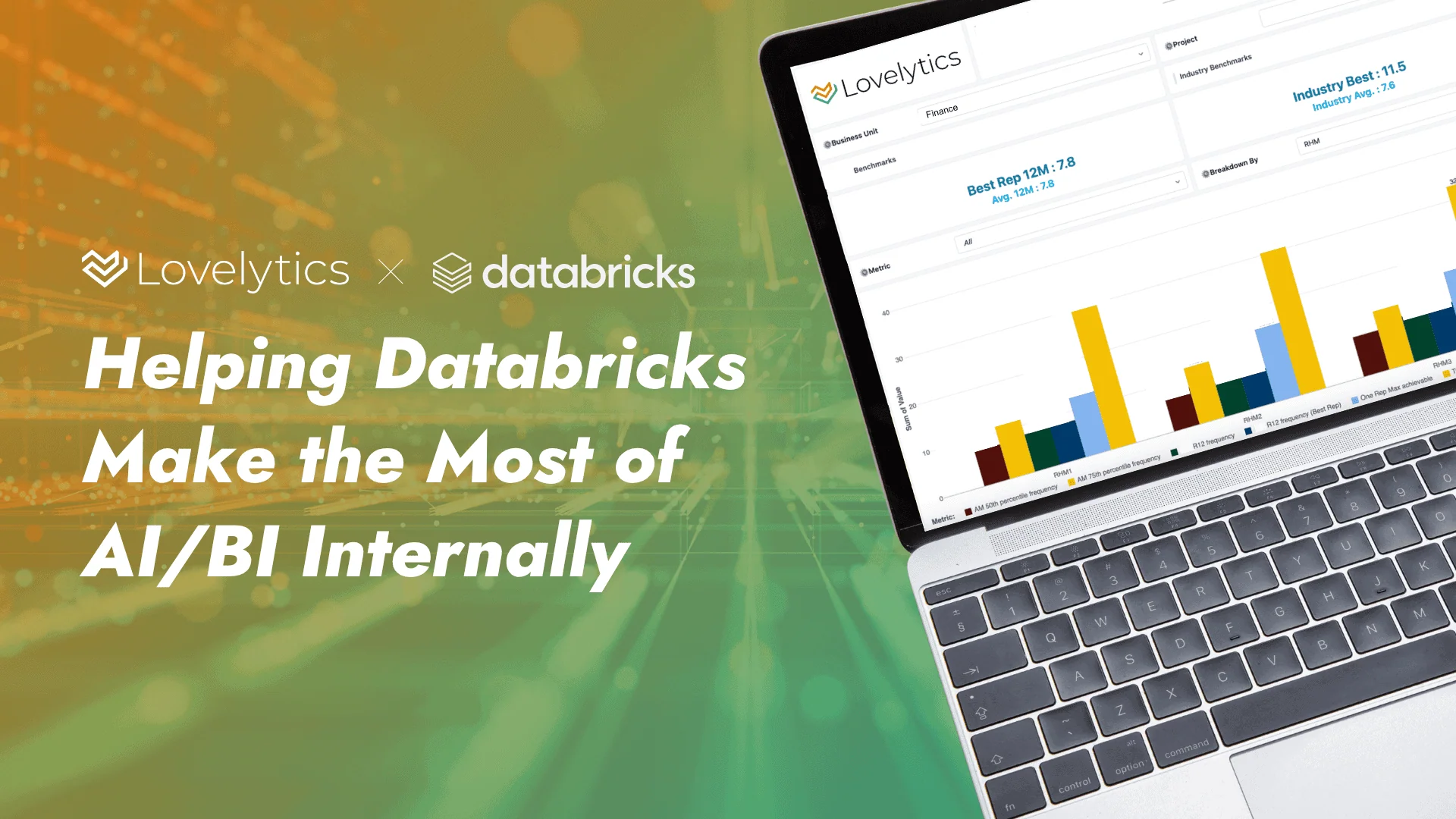
That’s exactly why Databricks committed to fully adopting its own AI/BI platform internally for operational and analytical reporting across various business units, launching the Databricks on Databricks initiative.
To bring that vision to life, they partnered with Lovelytics.
Leading From the Front: Lovelytics and Databricks’ AI/BI Migration
At Lovelytics, we help organizations modernize how they work with data. When Databricks asked us to lead the migration of their internal dashboards from an external BI and data visualization tool to their own AI/BI platform, it wasn’t just a typical project; it was part of their Databricks on Databricks initiative, where they committed to being their own best customer.
They selected Lovelytics for our deep expertise, proven delivery record, and unmatched experience within the Databricks ecosystem.
What started as a dashboard migration quickly became a collaborative effort to shape the AI/BI product itself. Together, we built automation tooling, provided real-time product feedback, and delivered results that included $880K in annual savings, 40% automation, and up to 5x faster performance.
Here’s how we made it happen and what it means for other organizations ready to adopt AI/BI.
Why Databricks Chose Lovelytics
We’ve built our reputation on deep business intelligence expertise and a close partnership with Databricks over hundreds of successful client engagements. We know reporting, and we know Databricks. And we know how to drive value quickly and efficiently.
When it came time to migrate mission-critical executive, sales, and marketing dashboards to AI/BI, Databricks brought us in to make it happen and to help work alongside them to shape what this tool would become for customers around the world.
“AI/BI represents a significant paradigm shift in business intelligence, offering a natural language interface, cost-effective licensing, and fast performance without the need for mini-ETLs,” said Aman Gupta, Senior Manager, Data Engineering, IT. “Our collaboration with Lovelytics supported our migration to AI/BI, leveraging their expertise and migration tools. For organizations considering a move to AI/BI, Lovelytics can provide experience, automation, and strategic guidance to help teams interact with BI in new ways and support broader data accessibility.”
The Four Key Objectives of the Program
The program with Databricks had four primary objectives:
- Successfully Migrate Dashboards: Migrate key internal dashboards to AI/BI with minimal-to-no business interruption.
- Partner with Product: Work closely with the Databricks product team to shape the roadmap and prioritize features.
- Change Management: Provide documentation and enablement to the end users to ensure a smooth transition.
- Automation Tooling: During the project, IP was developed to automate portions of the migration. In addition to being used during the project, a core goal was to develop something that could be released to the public for use in other migrations.
With these objectives in mind, Lovelytics and Databricks designed a project plan and partnership model to successfully achieve each key objective.
How It Was Executed
To deliver on Databricks’ vision for AI/BI, we broke the project into four structured phases, each with clear goals and outcomes:
1. Plan and Prioritize
We kicked things off with a deep dive into the existing BI and data visualization tool environment. This included a full audit of all dashboards, a functionality comparison between existing dashboards and AI/BI, a gap analysis to identify areas where the new platform needed enhancements, and an analysis of dashboard usage patterns to inform deprecation and consolidation decisions.
From there, we developed a migration plan aligned with Databricks’ product roadmap and chose four high-priority dashboards to migrate first to achieve a quick win.
2. Build and Migrate + Tooling
Over the next four sprints or 8 weeks, the Lovelytics team systematically migrated dashboards to AI/BI. This included converting calculations, redesigning visuals in the AI/BI interface, and configuring three priority AI/BI dashboards.
For each dashboard, we completed a round of feedback and validation to ensure everything matched the original BI and data visualization experience while leveraging the strengths of the new platform.
3. Automate and Accelerate
As we migrated, we worked alongside the Databricks team to build IP that automated repetitive tasks in the migration process. This tooling now supports about 40 percent of a typical migration, drastically reducing time and effort. It’s a foundational piece that will benefit both Databricks and any organization moving to AI/BI.
4. Enable and Support
Once the dashboards were live, we delivered training and documentation to help Databricks teams adopt the platform with confidence. We hosted live end-user sessions, enabled the IT team for self-sufficiency, and offered two weeks of post-launch support to ensure a smooth transition.
Accelerating Migrations with Reusable IP
One of the most exciting parts of the project came from our work on developing migration IP. Working closely with the Databricks team, we built automation tooling that streamlines nearly 40 percent of the migration process from the existing tool to AI/BI. That means faster execution, fewer errors, and more consistent delivery across clients.
We’re making this tooling available to all Databricks customers at no cost to help accelerate enterprise adoption of AI/BI and remove the friction of modernization.
Program Outcomes
In the end, this project was about Databricks showcasing their commitment and belief in AI/BI as the future of BI, by implementing it internally. In addition to the belief in the tool, a few key outcomes came out of the engagement:
● $880,000 in Annual Savings: Databricks was able to reduce annual costs by $880k by retiring their existing licenses in favor of AI/BI.
● 5x Performance Improvement: Delivered up to 5x faster performance for complex dashboards, empowering teams with quicker access to actionable insights.
● 40% Automation Achieved: Using the tooling developed, Lovelytics and Databricks were able to speed up the migration by 40% using tooling developed.
● Completed in Just 10 Weeks: The entire program, from planning to execution, leveraging our joint IP and accelerator, was completed in only 10 weeks. This significantly accelerated time to value and enabled Databricks teams to start benefiting from AI/BI much faster than traditional BI transformation timelines.
Interested in Migrating to AI/BI?
We would love to help you, and your organization migrate to Databricks AI/BI tool to realize cost savings and performance improvements.
Let us show you what’s possible with Databricks AI/BI. Reach out to Lovelytics today at [email protected]!