Embarking on a data platform migration can often feel like being trapped in quicksand – the more you struggle, the deeper you sink. Imagine if Lovelytics were your beacon of hope, ready to pull you from the quicksand and place you firmly on solid ground. Welcome to the second installment of our Migration March blog post series, where we deep dive into making the complex journey of migrating to Databricks manageable and delivering ROI. Together, we’ll demystify the process, cut through the technical jargon, dispel some myths, and uncover the tools that transform this daunting task into a rewarding adventure.
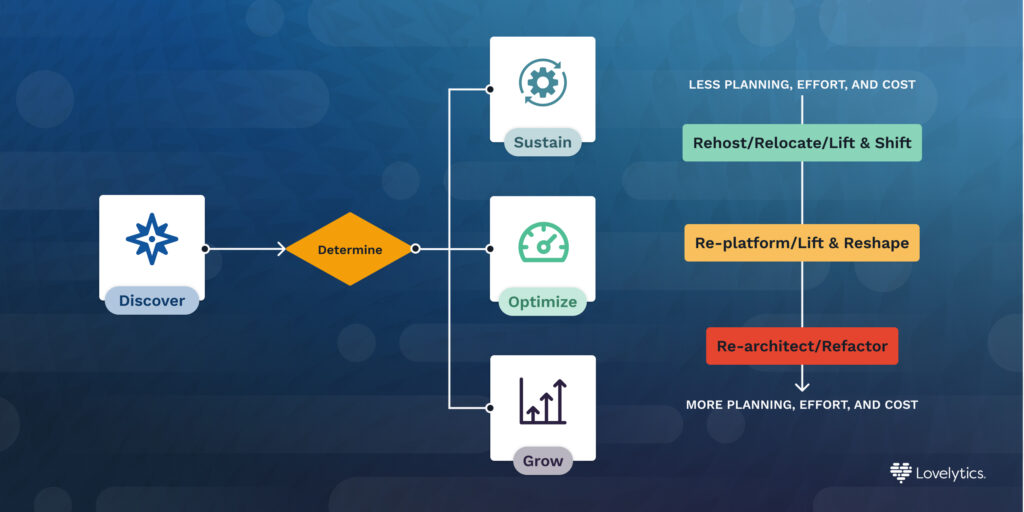
Navigating the 3Rs: Sustain, Optimize, Grow – A Simplified Approach to Modernizing Your Data Platform
In this visual, we’re exploring various strategies for modernizing your data platform, often referred to as the 3Rs: Rehost, Replatform, and Re-architect. The path we choose directly influences the migration’s speed, cost, and benefits, and hence, we name these as “Sustain,” “Optimize,” and “Grow.” Selecting the right strategy involves balancing numerous factors, such as business objectives, technical principles, prioritization criteria, and overall business strategy. Remember, it’s not about sticking rigidly to one approach for the entire migration; it’s about what is right for your organization.
Choosing a strategy can sometimes lead to conflicting priorities. For instance, you might aim for innovation and agility but must cut costs swiftly. Modernizing your data platform comprehensively can reduce expenses over time but requires a significant initial investment. An effective strategy might involve starting with less intensive approaches like rehosting or re-platforming to achieve quick wins and cost savings, which can then be reinvested into re-architecting modernization efforts down the line. This decision-making process can quickly become overwhelming, leading to analysis paralysis. However, we’ve honed a method over the years that simplifies these decisions.
Another challenge involves the specialized jargon encountered during migrations. Terms such as “Accelerators” are frequently used for various steps, leading to confusion. Accelerators play a vital role in inventory creation for scoping work, code conversion, automated validation, and beyond. However, mentioning automated programs operating in your environment can be a little scary. We aim to demystify these terms, enabling you to make knowledgeable decisions.
In the consulting realm, we frequently face diverse migration projects. These projects can seem overwhelmingly complex without the right tools to expedite the process. Accelerators, or productivity-enhancing tools, are essential for facilitating smoother and more efficient transition phases. Utilizing a blend of both traditional and innovative approaches, including rule-based programs and modern Large Language Models (LLMs), we aim to boost development speed and improve success rates in varied environments and project complexities.
For those who only occasionally engage in migration efforts, the jargon and tools specific to these processes may be unfamiliar, and the investment in such tools may seem unnecessary. However, we’ve got this aspect covered as well. We’ve developed in-house solutions, and Databricks also offers licensing for some of these tools.
You might wonder why using a profiler to figure out how many pipelines your system has is important. Interestingly, it’s common to find that many organizations do not have a full grasp of their current system inventory. This lack of awareness is especially prevalent where there is no dedicated data operations team or adherence to a production runbook that outlines all active and deprecated tasks. Profilers come into play here, offering a fast and efficient way to comb through system tables, SQL query logs, DDLs, and more, to provide a succinct summary of what’s under the hood. Think of these tools as intelligent parsers that not only understand the language of your system but can also, to a degree, translate it into the language of the target system(Databricks) during migrations. Although they might not be perfect, their ability to streamline and speed up the migration process is undeniable.
The “Factory Model” of execution is another concept worth noting. The “Factory Model” for execution is an intriguing strategy emphasizing a systematic approach, bringing together teams, tools, and processes to streamline migrations effectively. It incorporates lessons learned from past projects to enhance and optimize future migrations. Organizations with large IT portfolios benefit significantly from implementing this model. At the heart of the Factory Model lies the principle of establishing a repeatable process or framework designed to efficiently synchronize and manage data assets. This methodology particularly benefits companies undergoing major digital shifts, such as large-scale digital transformations, mergers, acquisitions, divestments, or transitions to cloud environments. The necessity for this model arises from the challenges associated with outdated systems, compartmentalized data, and unutilized (“dark”) data, prompting the development of migration factories.
The critical elements of the Factory Model include:
- Development of repeatable templates and rules
- Formation of teams with specialized skills
- Involvement of both business and technical experts
- Integration with service providers
Finally, data validation is arguably the most challenging aspect of migration. Automated processes have replaced manual checks, but identifying and debugging discrepancies remains complex. The key lies in experience – the more seasoned you are in performing validations, the better you become at identifying and preventing errors, especially in areas like timezones, data type conversions, data duplication, and truncation. The main point to remember is that quality assurance is critical to the migration process. It’s essential not to hurry through this stage. Instead, prepare a detailed checklist of data points to review
Demystifying Data Platform Migration: Common Myths vs. Reality
MIGRATION BEYOND A TO B: Migration is not merely moving data; it’s akin to moving homes. It demands thorough planning, ensuring compatibility, and optimizing performance in the new environment.
DATA COMPATABILITY: Expecting data to fit seamlessly into a new platform is unrealistic. Data often requires cleansing, mapping, and restructuring to leverage the new system’s full capabilities.
ONGOING JOURNEY: Migration is a continuous process of pilot migrations, full-scale transitions, and optimizations—not a one-time event.
TEAM EFFORT: Success hinges on cross-departmental collaboration. It’s not just an IT task but a collective effort to meet organizational needs.
UPFRONT DATA QUALITY: Addressing data quality from the start is essential. Postponing this can lead to compounded issues later.
TECH UPGRADES NEEDED: The transition may require new tools to handle the complexities of modern platforms, ensuring a smooth migration.
PLAN YOUR MIGRATION: A detailed migration plan outlines the roadmap to success, avoiding aimless efforts and focusing resources effectively.
PRACTICAL APPROACHES: Waiting for perfection can delay progress. Focusing on critical data and processes allows for incremental improvements and quicker benefits realization.
Understanding and addressing these misconceptions ensures a strategic approach to migration, leading to better outcomes and enhanced platform functionality.
Keep in mind – Lovelytics acts as your reliable guide, cutting through the dense mist of technical jargon and the complexities of decision-making, leading you into the clear skies of a successful Databricks migration. If you’ve come this far, it’s likely you’re considering a move to Databricks or are already on your way. In the future installment of our series, we’ll provide further insights on integrating Databricks as a Business-As-Usual (BAU) system and retiring the legacy platform once the migration validation is complete.
With Lovelytics, your data’s true potential is just a discovery away. Let’s uncover it together. Contact Us today.