In this article, we explain what generative artificial intelligence is, how it works, and provide examples of specific applications where it can be used daily.
Artificial intelligence (AI) has advanced significantly in recent decades. In this context, generative AI is one of the most attractive and promising fields in this discipline.
Generative AI is a technology that has the potential to revolutionize various industries, from entertainment to medicine. Generative AI not only analyzes and classifies data but also creates new content, from text to images and music.
What is generative AI?
Generative AI is a branch of AI that focuses on generating new content that is indistinguishable from content created by humans. Unlike traditional AI techniques—which are limited to recognizing patterns and making predictions based on existing data—generative AI can create new data from learned patterns.
One of the most important subfields of generative AI today is that of Large Language Models (LLM). These are a combination of algorithms that generate predictive text from a large amount of data. These language models were trained with large volumes of information. The big difference from what we already knew is the exponential growth of their capabilities: when we train a model with little data, its capabilities will be limited, but when the volume of data grows, its capabilities also grow (and significantly).
How does generative AI work?
Generative AI generally relies on deep learning models (a subfield of machine learning whose architectures, which simulate the way humans learn, allow for modeling and understanding more complex data), particularly generative neural networks.
There are various architectures that enable the training and inference of generative models. Below, we will explain two of the most popular: Diffusion Models and Autoregressive Models (such as GPT), and another important concept known as Foundational Models.
Diffusion Models
Diffusion models are a type of generative AI that produces unique photorealistic images from text and image prompts. An example of this is Stable Diffusion, which was originally released in 2022.
In addition to images, the model can also be used to create videos and animations. Some of the capabilities of these models include: text-to-image generation, image-to-image generation, creation of graphics, artworks, and logos, image editing and retouching, and video creation.
In this link, you can access one of these models and test its functionality.

Autoregressive Models
They are called this because they work by predicting the next unit of data based on the previous units (for example, the next word in a sequence of text). GPT (Generative Pre-trained Transformer) is an example of this type of model.
Let’s explain it with an example. Suppose the model’s input is: “The dog is the best friend.” Based on that input, the most likely prediction for the next unit of data (in this case, a word) would be “of,” and once having “The dog is the best friend of,” the next prediction—based on the previous units—would be “man,” thus completing the sentence: “The dog is the best friend of man.”
These models are trained on large datasets and can generate coherent and contextual text. Autoregressive modeling is an important component of GPT, which works with a type of architecture called Transformer, which basically consists of:
- An encoder that allows the understanding of natural language.
- A decoder for natural language generation.
In other words, an input sentence is taken and encoded, transforming it into numerical values and performing certain operations to understand the importance of each word and its relationship with other words in the same sentence. The decoder takes these numbers and, through mathematical operations, determines the next word to construct a complete and coherent sentence and deliver it as a response.
GPT uses only the decoder for autoregressive language modeling. This allows it to understand natural language and respond in a way that people can comprehend.

An LLM based on GPT predicts the next word by considering the probability distribution of the text corpus it is trained on. In other words, it emphasizes the flow of information from the previous words to the prediction of the next word.
Foundational Models (FM)
These are models trained on massive datasets to serve as a starting point for developing more specific models quickly and cost-effectively, rather than building AI systems from scratch.
A unique feature of these models is their adaptability, as they can perform a wide range of tasks with a high degree of accuracy. Some examples of these foundational models are: Bidirectional Encoder Representations from Transformers (BERT), GPT, Claude, Stable Diffusion, Hugging Face.
What are the applications of generative AI?
Generative AI has applications in a wide variety of fields. Below, we present some of the most notable ones:
1) Content Creation
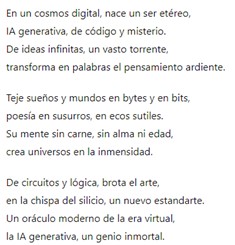
Generative AI is used to create textual content, such as articles, stories, and code. Models like GPT-4, LLAMA, and Gemeni have demonstrated impressive capabilities in generating coherent and relevant text.
2) Image and Art Generation
Diffusion models are used to create images and artworks. These images can be realistic or completely abstract, depending on the goal of the generator.

3) Music and Audio
Generative AI is also applied in the creation of music and sound effects. Models like Jukedeck and OpenAI’s MuseNet can compose musical pieces in a variety of styles and genres.
4) Video Games and Simulations
In video game development, generative AI can create environments, characters, and missions. This allows for a richer and more varied gaming experience. A clear example is Scenario, which enables the generation of landscapes, characters, and other elements related to video games.

Challenges and Ethical Considerations
Although generative AI offers many possibilities, it also presents challenges and ethical concerns. Some of the main challenges include:
- Quality and Realism: Although diffusion models and other generative models have improved significantly, sometimes the generated content can still be imperfect or unrealistic.
- Intellectual Property: Generating new content based on existing data raises questions about ownership and copyright.
- Malicious Use: Generative AI can be used to create fake news and misleading content, which can have serious social and political consequences.
- Bias: AI models can perpetuate or even amplify biases present in the training data. It is crucial for those working in development to identify and mitigate these biases.
—
This article was originally written in Spanish and translated into English by ChatGPT.
—
* This content was originally published on Datalytics.com. Datalytics and Lovelytics merged in January 2025.