


The first front is demand. Data/AI centers and electrification needs are pushing load growth to 8–15% CAGR in some regions (up from under 1% not long ago). The second is reliability: weather is no longer a seasonal risk with mild consequences; “extreme” has quietly become the new average, and grid complexity is rising right alongside it.
And the third front is regulatory pressure, adding a layer of volatility on top of the other two just when utilities can least afford it.
Three fronts, one war.
Most utilities are still fighting it division by division, a demand-forecasting initiative here, a reliability pilot there, without a unified strategy that treats it as the single fight it actually is.
The good news? A handful of energy, utility, and oil & gas companies have already cracked the code. They’re not just surviving this war, they’re turning AI into an enduring competitive advantage.
In this blog, I’ll share what’s helping our top energy clients move past the pilot-program graveyard and into results like 30% grid efficiency gains, a 40% reduction in manual inspection costs, and $20M in incremental revenue.
The cost of standing still in 2027
The instinct in the face of all this is to move fast via funding more AI pilots, standing up more dashboards, buying more point solutions. But speed without a foundation is how utilities end up in what we call the pilot trap.
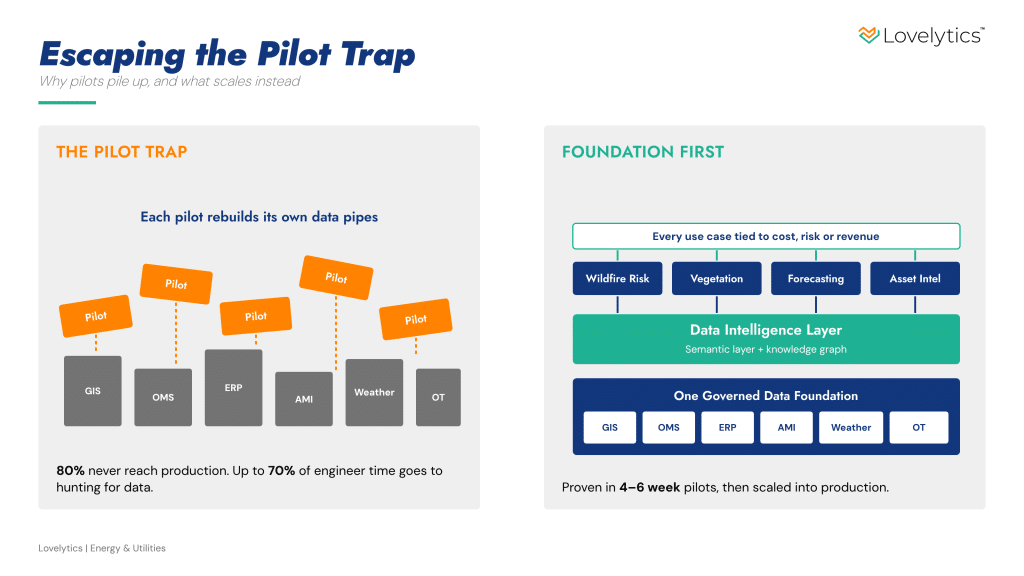
Roughly 80% of utility AI projects fail to scale, not because the models are bad, but because the data underneath them is fragmented across GIS, OMS, ERP, and a dozen other systems that were never built to talk to each other.
We’ve seen engineers spend up to 70% of their time just hunting for the data they need before they can even start solving the problem in front of them.
That data debt has a price tag.
It shows up as stranded assets and emergency power costs when utilities can’t see risk coming. It shows up as a widening gap between rising rates and declining reliability, a collision that’s as much a trust and public-relations problem as it is a financial one.
And it shows up in board rooms, where “we ran a successful pilot” is no longer an answer anyone wants to hear. Pilot programs don’t scale and they aren’t a strategy. They are an expensive proof that the idea works but it will likely sit next to a growing pile of others just like it.
So, what’s the fix?
The Lovelytics point of view: foundation first, value always
Here’s where we differ from a lot of the AI conversation happening in this industry: we don’t think the answer is more AI. We think the answer is the *right order of operations*.
You can’t automate what you can’t see
Before a utility can get to predictive maintenance, autonomous agents, or closed-loop grid control, it needs a single, governed view of its data (asset data, AMI, geospatial, weather, OT, etc) unified in one place instead of scattered across silos.
We think of this as building a data intelligence layer: a semantic layer and knowledge graph sitting on top of the raw data that gives every team, and eventually every AI agent, a common language for what’s actually happening on the grid. Skip this step and you’re not building AI maturity, you’re building a faster way to generate reports nobody trusts.
What is a semantic layer or ontology, and why does it matter for grid data?
To make that concrete, a semantic layer is a layer of business meaning that sits on top of raw data. It defines what a “circuit segment” or an “asset risk score” actually means, so every team and every AI system works from the same definitions. An ontology builds on this by turning those definitions into a knowledge graph that maps how the concepts relate to each other: an asset connects to a feeder, a feeder to a risk zone, and a risk zone to a crew.
Together, they let a utility query and reason across data that was previously siloed, including AMI, geospatial, weather, and OT, as a single connected picture rather than a set of disconnected tables. This is the layer that turns “we have a lot of data” into “we have a shared source of truth.” It is also the difference between an AI use case that scales and one that quietly becomes shelfware.
Every use case starts with a value driver, not a technology
Before we write a line of code, we ask a deceptively simple question: is this initiative reducing cost, reducing risk, or growing revenue? That answer determines how we measure it, and it’s what lets us build an ROI calculator on day one instead of trying to justify the investment after the fact.
Utility leaders don’t have the patience for AI theater anymore, they need a number attached to the outcome, and they need it early.
**Prove it in weeks, not years**
We deliberately scope pilots to four-to-six weeks. Not because the problems are small, but because complexity kills momentum, and a utility that’s still scoping a project eighteen months in has already lost the argument internally. A tight pilot proves the “art of the possible” fast enough that it can be funded, scaled, and put into production before the organization loses conviction.
This isn’t theoretical. It’s how we approached one of the most consequential use cases in the industry today.
What are the highest-ROI AI use cases for utilities right now?
For utilities with the resources to make a significant move, modernizing Advanced Metering Infrastructure (AMI) data and building geospatial risk models consistently deliver the clearest returns.
AMI modernization unlocks grid visibility that’s foundational to almost every downstream use case, while combining grid data with geospatial, LiDAR, and weather data enables proactive risk models for wildfire mitigation, vegetation management, storm response, and automated asset inspections.
What this looks like at grid scale
Before, wildfire response was reactive: crews responded after ignition, and public safety power shutoffs were a blunt instrument deployed with limited visibility into where they’d actually help. By migrating asset data onto a modern platform and fusing it with geospatial, LiDAR, and weather data, we helped build a wildfire AI mitigation model that flips that posture from reactive to predictive.
This allows command centers three-to-five days of advance warning on extreme weather and its likely grid impact, plenty of lead time to make genuinely informed calls on public safety power shutoffs instead of guessing.
The results since the model went into production speak for themselves: average outage duration cut in half, from 24 hours to 12. Ten thousand poles replaced proactively based on modeled risk instead of after failure. And the utility now covers 64 PSPS-eligible feeders and 118,000 customers with a level of precision (down to the circuit segment) that simply wasn’t possible when the data lived in silos.
The same foundation paid off in a completely different use case. Grid modernization work at Xcel replaced monthly manual spreadsheet investigations of outage events with a real-time, governed tool and took investigation cycle time from a full month down to seven days, while giving engineers 76% more capacity for planning and analysis instead of data wrangling.
It’s the same pattern twice: unify the data, attach it to a clear value driver, and the AI use case that follows practically builds itself.
That’s the throughline across every high-value use case we see in this industry, whether it’s wildfire mitigation, vegetation management, AMI-driven demand forecasting, asset intelligence, or energy trading optimization: the breakthrough isn’t the model. It’s the data foundation and the discipline to prove value before scaling.
Xcel Energy didn’t escape the pilot trap by running more pilots. See what they did instead and what it took to turn a unified data foundation into $3M in annual value.
4 questions to ask before your next AI investment
If you’re setting AI strategy for a utility in 2027, here’s where we’d point your attention:
- Where is your data debt actually costing you? Not in the abstract, in engineer hours, in delayed investigations, in decisions made on stale information.
- Can you name the value driver for every AI initiative on your roadmap? If the answer for a given project is “we’re not sure yet,” that’s a signal to pause, not to accelerate.
- Are your highest-resource bets going toward AMI modernization and geospatial risk modeling? These two remain the highest-leverage plays for utilities with the capital to make a real move. They unlock grid visibility and proactive asset risk management that smaller initiatives can’t.
- Is your AI partner upskilling your team, or replacing them? The utilities getting the most out of this moment are treating their technology partners as an extension of their own team, or a “two in a box” model that transfers capability, not just code.
The grid paradox isn’t going away. Demand isn’t slowing down, weather isn’t getting calmer, and regulators aren’t getting less demanding. But utilities that get the foundation right (data first, value always, proof before scale) aren’t just keeping up with that pressure. They’re turning it into the case for the investment they needed to make anyway.
If you’re looking for guidance on how to avoid the pilot trap and start getting measurable value from your data, our team would love to help. Lovelytics is a Databricks Partner of the Year and works exclusively with energy, utility, and oil & gas leaders to turn fragmented grid data into governed, production-grade AI. If you want to talk through where your organization stands on this journey, reach out to our Energy & Utilities team.
FAQ
Why do most utility AI pilots fail to scale?
Roughly 80% of utility AI projects fail to scale, and it’s rarely because the underlying model is flawed. It’s because the data feeding it is fragmented across legacy silos, so a pilot that works on a clean, hand-picked dataset breaks down the moment it meets production-scale, messy, cross-system data. Without a unified data foundation, every new AI use case has to solve the same integration problem from scratch, which is why pilots pile up instead of turning into production systems.
What is “data debt” in the utility industry?
Data debt is the accumulated cost of storing critical grid data (GIS, OMS, ERP, AMI, weather, asset OT) in disconnected systems instead of a unified platform. Left unaddressed, it forces utilities into a permanent state of reactive maintenance, since engineers spend more time locating and reconciling data than analyzing it. In some organizations we’ve worked with, engineers lose up to 70% of their time this way before they can even start solving the problem in front of them.
How long should an AI pilot take at a utility?
We recommend scoping utility AI pilots to four-to-six weeks. Longer pilots tend to expand in scope faster than they prove value, and a utility still scoping a project eighteen months in has usually already lost the internal momentum needed to fund production rollout. A tight pilot is designed to prove the “art of the possible” fast enough to justify scaling it.